The NeuroD group’s second publication in 2026 is also out now. Funnily enough, this article was published in the same issue of Neurobiology of Disease as the first publication! This article is the result of a collaboration between the NeuroD group (Laurie, Barry, Linda, Ronald, and Willeke) and the Leiden Academic Centre for Drug Research (LACDR; Laura Heitman). In this publication, we describe a method to measure differences in cellular response in neuronal cells.
Spinocerebellar Ataxia Type 1 (SCA1) is an inherited brain disorder in which nerve cells important for coordination and movement gradually become damaged. In this study, we grew human nerve cells from induced pluripotent stem cells (iPSCs) derived from people with SCA1, allowing us to study the disease in relevant human cells in the laboratory. We focused on metabotropic glutamate receptors, proteins that play an important role in communication between nerve cells. To investigate how these receptors respond to different substances, we used an impedance-based assay that measures small electrical changes when cells react to compounds that affect these receptors. This technique allowed us to measure the overall response of the cells, rather than just one specific signal. By applying different receptor-targeting compounds, we observed clear patterns in how the cells responded, creating a functional “profile” for each compound. These profiles help us better understand how different substances influence receptor activity in human neurons. Our results suggest that this method could be a useful tool for studying neuronal signaling and for exploring potential treatments for neurological diseases such as SCA1.
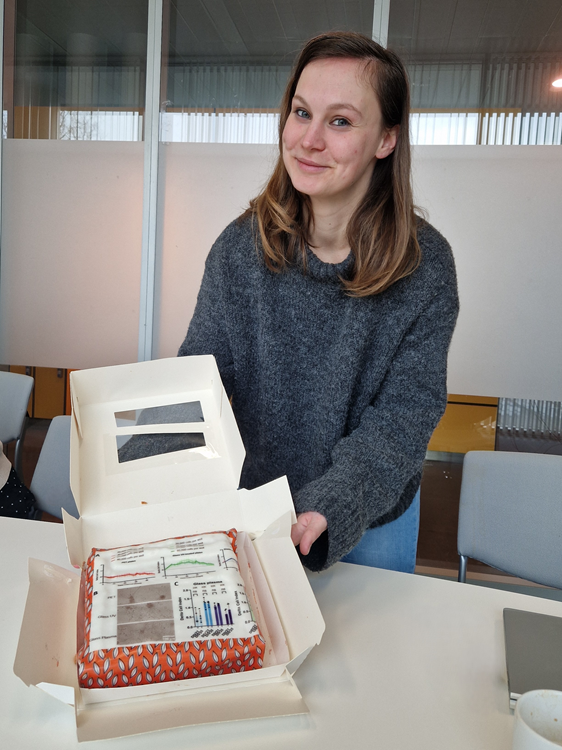
Of course we had cake to celebrate this as well.